Premise and Scope Conditions
Assume the following throughout:
- Identifiability. Players capable of Generalized Tit-for-Tat (GTfT) and players incapable of GTfT can be identified and separated in advance (ex ante observability of type).
- No noise. Actions are executed and observed without error. (Under noise, all-TfT populations suffer retaliation cascades, and more forgiving strategies such as Generous TfT or Win-Stay-Lose-Shift outperform strict TfT. The claims below do not extend to noisy settings.)
- Fixed types. Player types do not change or adapt over the horizon considered.
- Sufficient patience. The discount factor is high enough (or the expected number of rounds large enough) that one-shot deviation gains are outweighed by the loss of future cooperation.
- Scope of "non-GTfT." In Q3 and Layer 2, "non-GTfT players" refers to players following non-responsive strategies — unconditional cooperation (All-C), unconditional defection (All-D), or random play. Players who are responsive but not strictly TfT (e.g., Grim Trigger, Pavlov, imperfect human reciprocators) are treated as reciprocators and belong in Layer 1. The operative boundary is responsiveness (reciprocity), not literal TfT capability.
Q1. Pareto Efficiency and Equilibrium of All-TfT
Claim. In the iterated Prisoner's Dilemma — two-player or n-player under standard payoff conditions (T > R > P > S and 2R > T + S) — when all participants adopt tit-for-tat, the resulting long-run payoff profile (mutual cooperation, payoff R for every player each round) is Pareto-efficient: no player's payoff can be raised without lowering another's.
A. True, with the following clarifications:
- The claim is Pareto efficiency, not Pareto dominance. The all-TfT profile does not yield higher payoffs than every other profile for every player: in a profile where one player exploits an unconditional cooperator, the exploiter earns T > R. Such exploitation profiles are themselves Pareto-efficient (moving to mutual cooperation would lower the exploiter's payoff). Pareto efficiency alone therefore does not single out all-TfT.
- What does distinguish all-TfT is the combination of properties: (i) Pareto efficiency, (ii) Nash equilibrium — given sufficient patience, a unilateral deviation to defection earns T once and then P forever, which is strictly worse than the stream of R, so no player can profit by deviating — and (iii) symmetry — every player receives the same payoff. Among the many equilibria guaranteed by the folk theorem, all-TfT implements one that is efficient and egalitarian, and does so in a self-enforcing way.
Q2. All-Cooperate vs. All-Tit-for-Tat
Given Q1: when every player cooperates unconditionally versus when every player plays tit-for-tat, are the expected payoffs identical?
A. Yes. In a population where no one defects, tit-for-tat behaves identically to unconditional cooperation — every round produces mutual cooperation, and the payoff profiles coincide (both are Pareto-efficient in the sense of Q1). The difference is robustness, and this is where TfT's specific advantage lies, since Q1's efficiency property is shared by All-C:
- A defector who enters an All-C population earns the temptation payoff T indefinitely; unconditional cooperation is not an equilibrium against entry.
- Against TfT, exploitation is limited to a single round, after which the defector faces retaliation and earns at most P. All-TfT deters entry; all-All-C invites it.
TfT's superiority over All-C therefore rests entirely on this robustness argument, not on any payoff difference within a fully cooperative population.
Q3. Optimal Response to Non-Responsive Players
When some players follow non-responsive strategies (per Premise 5), do GTfT-capable players maximize their own group's payoff by playing TfT among themselves and applying an All-D-or-exclusion policy to non-responsive players?
A. Yes, within the stated scope. The objective function here is the payoff of the GTfT-capable group (not total welfare), over a horizon in which types are fixed. Under those conditions:
- Against All-C: playing All-D yields T > R per round; exclusion yields the outside option (normalized to 0). Since T > 0, interaction-with-defection maximizes the group's payoff. (Note: this is exploitation. Because T + S < 2R, it destroys joint surplus and is not Pareto-superior — it is optimal only relative to the group-payoff objective.)
- Against All-D or random players: cooperation is strictly dominated (it yields S with no prospect of inducing reciprocity). The choice is between playing All-D (payoff P) and exclusion (payoff 0): interact if P > 0, exclude if P < 0.
- Against responsive non-TfT players (Grim, Pavlov, etc.): the blanket policy does not apply. Defecting against a responsive player trades a one-time gain of T for the permanent loss of the R-stream and is strictly suboptimal. Such players must be classified into Layer 1.
Two caveats bound this result. First, sustained exploitation of All-C players assumes they never learn, exit, or mutate into defectors; over longer horizons with adaptive types, the T-stream is not guaranteed and exploitation may erode the pool it feeds on. Second, if the objective were total welfare rather than group payoff, exclusion or even cooperation-with-forgiveness could dominate exploitation.
Two-Layer Network Structure
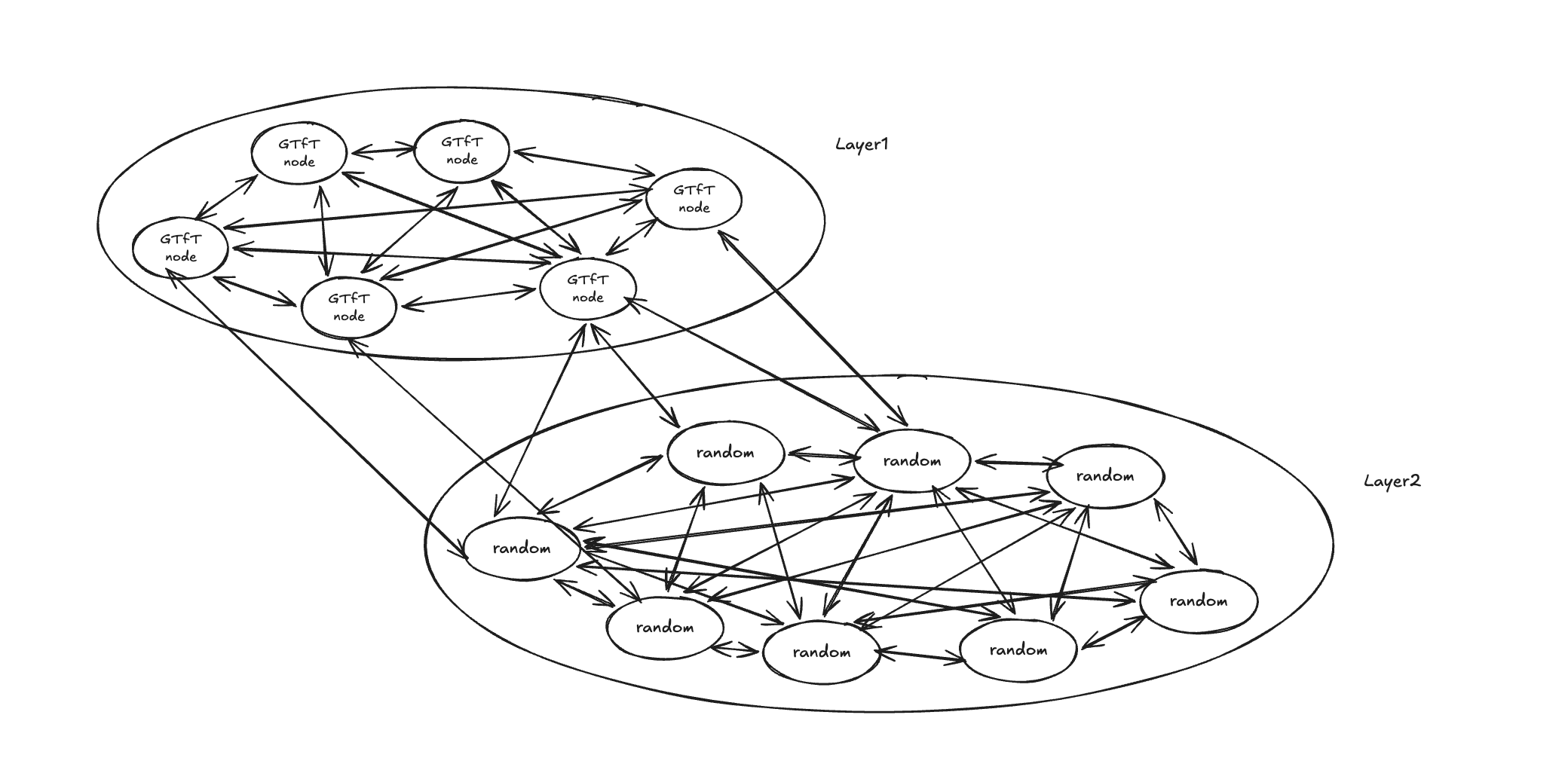
If Q1–Q3 hold under the stated premises, the group-payoff-maximizing network for reciprocity-capable players is:
| Layer | Interaction | Strategy | Payoff character |
|---|---|---|---|
| Layer 1 | Reciprocator ↔ Reciprocator (TfT-capable and other responsive strategies) | TfT / conditional cooperation | Efficient, symmetric, self-enforcing (R per round) |
| Layer 2 | Reciprocator ↔ Non-responsive player | All-D if the interaction payoff is positive (T against All-C, P > 0 against All-D); exclusion otherwise | Group-payoff-maximized / loss-minimized |
Why This Structure Is Optimal (Under the Premises)
-
Layer 1 sustains the cooperative equilibrium. Because every participant is responsive, defection is immediately punished and cooperation is self-enforcing (Nash), Pareto-efficient, and symmetric (Q1). It matches unconditional cooperation in payoff while being strictly more robust to entry by defectors (Q2).
-
Layer 2 prevents subsidy of non-reciprocity. Non-responsive players cannot sustain the punishment mechanism that makes cooperation incentive-compatible. The All-D-or-exclusion policy ensures reciprocators never unilaterally cooperate with players who cannot respond to it (Q3). The choice between All-D and exclusion is determined by the sign of the interaction payoff, not applied uniformly.
-
The boundary is maintained by the identifiability premise. Because classification determines payoffs, non-reciprocators have an incentive to mimic reciprocators; the structure's feasibility therefore depends on the assumed observability being robust to mimicry (a signaling problem outside this model's scope). Without reliable identification, reciprocators cannot distinguish responsive partners from exploiters and the cooperative equilibrium unravels.
Implication
Within the model's assumptions — no noise, fixed and observable types, sufficient patience, and a group-payoff objective — the optimal network is not one where everyone cooperates unconditionally. It is one where cooperation is conditional and bounded: extended fully within a verified reciprocal group (defined by responsiveness, not by strict TfT capability) and withheld from non-responsive players outside it. The network's optimality derives not from universal goodwill but from the structural enforcement of reciprocity.
Relaxing any assumption changes the answer at the margin: noise favors generosity over strict retaliation; adaptive types undermine sustained exploitation; imperfect observability introduces mimicry and screening costs; and a total-welfare objective penalizes exploitation of cooperators. The two-layer structure should be read as a benchmark for the idealized case, not as a general prescription.